
What is a clinical research study?
A clinical research study—commonly referred to as a clinical trial—is a cornerstone of medical advancement. It involves investigating new methods of diagnosing, treating, and preventing diseases. These studies help us understand human health better and develop life-saving medications and therapies.
Why are clinical trials important? Thanks to clinical research, illnesses like polio, smallpox, and leprosy are no longer widespread. Ongoing advancements continue to bring hope for cures to conditions like cancer, HIV, and Alzheimer’s within our lifetime.
The Evolution of Clinical Research
The evolution of clinical research spans centuries, beginning with observational trials and evolving into today’s rigorous, highly controlled studies. The journey is filled with breakthroughs that have shaped modern medicine. Test your knowledge with these fascinating clinical research facts!
The First Clinical Trial in History
Do you know the earliest reference to a clinical trial?
It dates back to the Book of Daniel in the Bible. King Nebuchadnezzar ordered people to consume only meat and wine. However, a group objected, choosing a plant-based diet of legumes and water instead. After ten days, they were found healthier, and the king permitted the diet. Though informal, this marked one of the earliest recorded clinical experiments.
The First Physician-Led Clinical Trial
When was the first physician-conducted clinical trial?
On May 20, 1747, Dr. James Lind conducted a controlled study aboard the HMS Salisbury to test treatments for scurvy. He discovered citrus fruits like lemons and oranges were effective. This date is now celebrated as International Clinical Trials Day.
Are Clinical Trials Becoming More or Less Expensive?
Despite technological advances, clinical trials today are more sophisticated and costly. While costs have decreased in some phases due to automation, developing a single successful drug now costs an estimated $2.6 billion, compared to $179 million in the 1970s.
Fun Clinical Research Facts
When was aspirin first used?
Aspirin has ancient roots, with evidence of use dating back to 3000 BC. The name “aspirin” was coined by Bayer in 1899, and it remains one of the most widely studied medications.
What was the first genetically engineered drug?
In 1982, the FDA approved Humulin, the first genetically engineered medication. Scientists used recombinant DNA to insert human insulin genes into bacteria, leading to lab-synthesized insulin.
True or False: Childhood Cancer Survival Rates Have Improved Due to Clinical Trials?
True.
In the 1950s, childhood cancer survival rates were below 10%. Today, thanks to clinical research studies, survival rates exceed 80%. This is a powerful example of why clinical trials are important—they save lives and continuously improve treatment methods.
What Is the Placebo Effect in Clinical Trials?
The placebo effect occurs when a participant experiences real health improvements despite receiving a treatment with no active ingredients. Placebos are critical in clinical trials to compare the true effects of a new drug or therapy. They help researchers ensure results are due to the treatment itself, not expectations.
Clinical Research Training at Bay River College
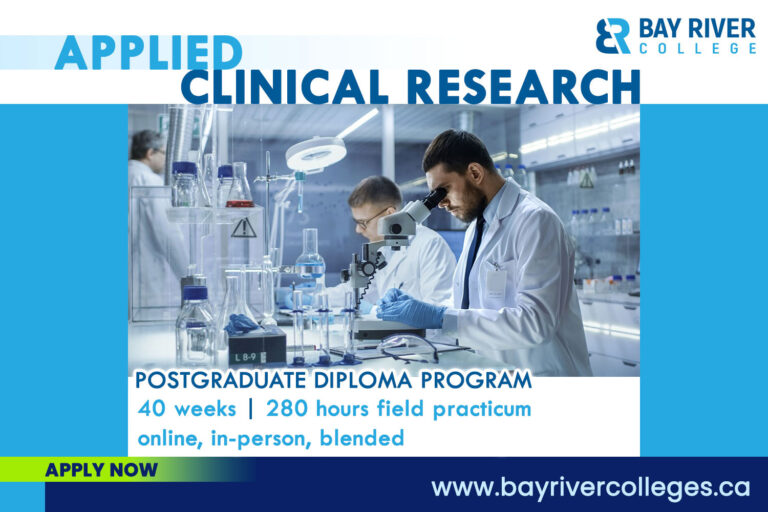
Bay River College offers a specialized Applied Clinical Research Post-Graduate Program designed for students ready to enter the field of clinical research. Our program provides robust theoretical foundations and hands-on training with industry professionals, preparing graduates to contribute meaningfully to this essential sector.
If you’re passionate about advancing healthcare, a clinical research study program at Bay River College is the perfect place to start.
Frequently Asked Questions
Question: What should I know about clinical research?
Answer: Clinical research involves studying new treatments, therapies, or medical devices to determine their safety and effectiveness. These studies are essential for advancing healthcare and can include clinical trials, observational studies, and lab-based investigations.
Question: Which are the 5 most important documents in clinical trials and why?
Answer: The five most important documents in a clinical trial include:
- Protocol – outlines the trial’s objectives, design, and methodology
- Investigator’s Brochure (IB): provides clinical and non-clinical data on the investigational product
- Informed Consent Form (ICF): ensures participants understand their role and the risks involved
- Case Report Form (CRF): collects all required data from each participant
- Ethics Committee Approval: confirms that the study meets ethical and regulatory standards
These documents ensure that the trial is scientifically sound, ethically conducted, and well-documented throughout the clinical research process.
Question: What are the advantages of clinical trials in research?
Answer: Clinical trials provide numerous benefits. They help determine the safety and efficacy of new treatments, contribute to medical innovation, and improve patient outcomes. Participants may also access cutting-edge therapies not yet available to the public. This is why clinical trials are important—they play a key role in the evolution of treatment standards and scientific understanding.
Question: What is the importance of clinical research?
Answer: The importance of clinical research lies in its ability to transform medicine. From the first clinical trial in history to today’s high-tech studies, clinical research uncovers critical data that leads to better treatments, cures, and preventative strategies. It ensures that healthcare is based on evidence, not assumptions, and continuously drives forward the boundaries of what’s medically possible.