
Search
Search

Infection Prevention and Control (IPAC) Program

  • Credential: IPAC Endorsed by IPAC Canada
  • Type: Complete Certification
  • Study Options: Online
  • Duration: 16 weeks
  • Professional Level: Professional development – Career Upgrade
  • Intake: Available
    • Summer: May~ September (2026 intake available)
    • Fall: September ~ December (2026 intake available)
    • Winter: January ~ April (2026 intake available)
  • Next Starting Date: October 8 , 2026

Unbeatable price! Register for only $1499 CAD
IPAC Training Calgary - Bay River College IPAC Infection Prevention and Control

Online Course

Learn at your home with 100 hours of interactive and synchronous online learning over 16 weeks - 14 units

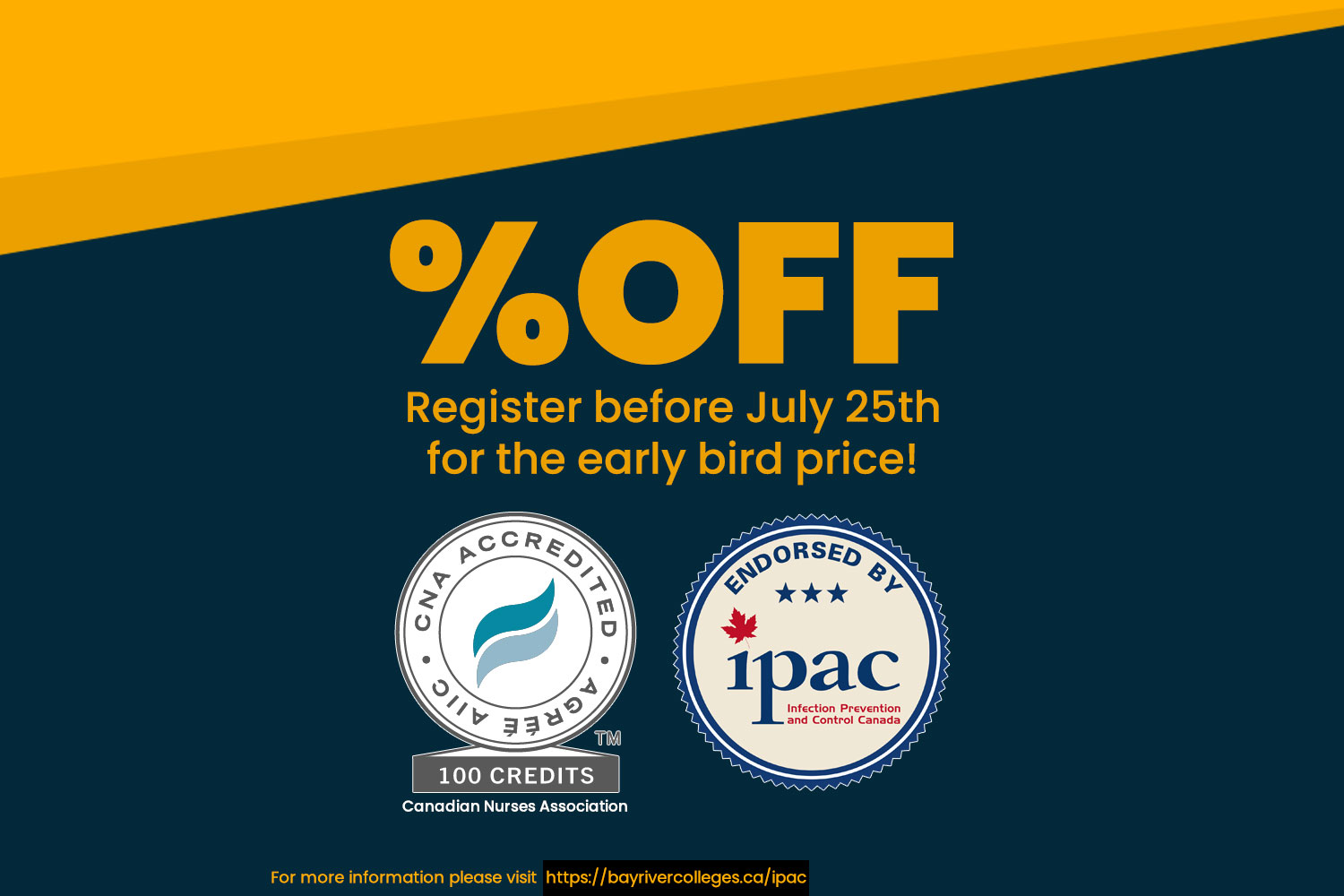
Endorsed by IPAC Canada

This online program covers all IPAC/APIC Canada professional practice standards, endorsed by IPAC Canada

Accredited by Canadian Nurses Association CNA

Accredited by Canadian Nurses Association CNA
100 credit hours towards RNs, RPNs, and LPNs

Prepare yourself for CBIC Exam

Course curriculum and programs of study based on the Certification Board of Infection Control & Epidemiology's CBIC Exam

Up-to-date

Education materials has been regularly assessed and annually reviewed to reflect current pedagogical approaches of IPAC/PCI

Course Information

Overview

Bay River College’s 16-week Infection Prevention and Control (IPAC) Program is an online-based, interactive program endorsed by IPAC Canada. This program is designed for frontline healthcare workers and health professionals who are looking to enter the field of Infection Prevention and Control.

The primary learning goals of this course are to increase students’ theoretical knowledge and to develop practical skills to prevent infections and diseases, as well as to solve real healthcare problems. Infection prevention and control (IPAC) is an evidence-based practice that, when applied consistently and effectively, can reduce or prevent the transmission of microorganisms.

The IPAC course is a fully online program with interactive content for health professionals who are new to, or preparing to enter, the field of IPAC. The purpose of the course is to introduce learners to IPAC practices and to enhance their knowledge and skills in managing, preventing, and controlling infections and diseases.

This comprehensive IPAC certificate program is grounded in systems theory and practical skills, providing students with the knowledge and forward-thinking education needed to take on leadership roles in the field as IPAC professionals.

The Infection Prevention and Control Program is a facilitated, asynchronous, and self-directed program that offers flexibility for students to progress and complete the training within the allotted time. By using industry-relevant theories, students will learn the principles of planning, implementing, managing, and evaluating infection prevention and control in various Canadian healthcare settings.

The Infection Prevention and Control Program is a facilitated, synchronous, and self-determined program that gives the schedule flexibility for students to progress and finally complete the training in the allotted time. By providing and utilizing industry-related theories, students will learn and be equipped with the principles of planning, implementing, managing, and also evaluating infection and prevention control in all Canadian health care settings.

Learning Outcomes

Upon completion of this program, participants will be able to:

  1. Recognize the essential principles and fundamentals of microbiology and epidemiology in relation to Infection Prevention and Control (IPAC).
  2. Analyze and evaluate various scenarios to develop problem-solving skills for IPAC.
  3. Demonstrate critical thinking and managerial abilities in:
    • Implementing routine practices and additional precautions
    • Conducting surveillance
    • Managing outbreaks in public and clinical health settings
  4. Collaborate with professional and academic organizations to develop health and safety programs that support IPAC Canada protocols.
  5. Assess risk factors and patterns to develop prevention and control strategies for populations.
  6. Apply research and lifelong learning skills by actively participating in case-based studies and online learning communities.

Topics include

This course includes the following topics and modules:

  • Adult Education and Literature Research in IPAC
  • Clinical Microbiology in Infection Prevention and Control
  • Nosocomial and Community-Associated Infections / Routine and Additional Practices
  • Laboratory Approaches to Antimicrobial Resistance
  • Antimicrobial Stewardship
  • Basic Concepts of Epidemiology
  • Surveillance / Surveillance Programs
  • Outbreak Identification and Response
  • Occupational Health and Safety / Environmental Sanitation
  • Facility Design and Development
  • Communication and Leadership in IPAC
  • Management and Professionalism in IPAC

Why become an Infection Prevention and Control (IPAC) Practitioner?

Generally, Infection Prevention and Control Practitioners (ICP) are professionals who have dedicated their careers to preventing the spread of infections in health care settings. Infection Prevention and Control Practitioners (ICPs) are professionals dedicated to preventing the spread of infections in healthcare settings.

ICPs work as part of Infection Prevention and Control (IPAC) teams in a variety of settings, including hospitals, long-term care facilities, public health authorities, ministries, and consulting companies. ICPs come from diverse professional backgrounds, including nursing, epidemiology, public health, microbiology, laboratory technology, and medicine. One of the key achievements in an IPAC career is obtaining CIC certification through the Certification Board of Infection Control and Epidemiology.

How to Take the Infection Prevention and Control Online Course and Get My Certification?

If you are an individual who enjoys collaborating with multiple departments, including nursing, housekeeping, maintenance, laboratory, and pharmacy, among others; enjoys a challenging role; and is interested in investigative work to find answers, then this may be the right career path for you. This field is ideal for those who want a career where they can impact many lives and improve outcomes by sharing their expertise.

To succeed in this role, you should be an effective team player with strong interpersonal and collaboration skills. If you are looking for the next step in your career with a desire to help others, you should consider applying for this course to begin your journey toward obtaining your Infection Prevention and Control certification.

Some Career Perspective

  • Public health units
  • Congregate settings such as shelters, group homes, correctional facilities, and children or youth residential settings
  • Hospitals, including acute care, rehabilitation, mental health/addictions, and dialysis
  • Long-term care facilities
  • Retirement facilities
Infection Prevention & Control
Any inquiries? Contact an advisor using the form below.
Start Your Application Now

Learn more about our Infection Prevention and Control (IPAC) certification

IPAC course IPAC certification

In order to ensure optimal infection control practices across Canadian healthcare facilities, it is essential that all personnel involved in communicable disease management, including those working in hospitals, clinics, and health units, have acquired specific qualifications. The preferred credentials for these roles include RN, RPN, BSc, CRT/RRT, MD, or MLT, or an equivalent certification such as Nurses and Microbiologists: sign up here.

However, if you do not possess these specific credentials, we strongly advise having relevant experience in the field of Infection Prevention and Control (IPAC). At Bay River College, we take into account a candidate's educational background as well as their work experience, considering a combination of both factors when assessing eligibility for such positions. If you have any questions please don't hesitate to contact us.

This course has received endorsement from IPAC Canada and accredited by Canadian Nurses Association CNA. This online course has recently undergone a redesign to ensure the content aligns with the latest advancements in Infection Prevention and Control. The updates also incorporate current pedagogical strategies to enhance the learning experience. As an endorsed course by IPAC Canada, this course comprehensively covers all the professional practice standards set by IPAC Canada (formerly known as the Community and Hospital Infection Control Association) and APIC (Association for Practitioners in Infection Control and Epidemiology).

Additionally, the curriculum of this course is based on the Examination Content Outline provided by the Certification Board of Infection Control and Epidemiology (CBIC), which can be accessed on the CBIC website.

We conduct surveys among learners at the end of each cohort. According to the most recent surveys, learners confirm dedicating an average of 7-12 hours per week to coursework. This time includes engaging with modules, participating in discussions, completing assignments, and taking quizzes. The exact amount of time spent may vary depending on each learner's familiarity with the topics covered that week and their prior experience in the field of Infection Prevention and Control (IPAC).

The Infection Prevention and Control Online Course is conducted in English, and both participants and instructors will use English as the medium of instruction and communication, both verbally and electronically. To ensure effective communication with instructors and fellow classmates, it is essential for all applicants admitted to this course to possess a sufficient level of English comprehension.

This IPAC course is designed as a 16-week journey, encompassing 14 modules. Each week, a new module is released, allowing all learners to progress together as a cohort. To ensure comprehensive understanding, assessments are provided at the end of each week.

The assessment structure for the IPAC program is based on the program activities. The weighting percentage of each activity are vary. These assessments encompass a variety of components such as discussion participation, quizzes, assignments, and final essay. The final grade for the course will be calculated from the cumulative marks achieved on these program activities.

If any concerns you have in regard to accessibility, we encourage you to contact the coordinator at [email protected] before proceeding, as they can provide further guidance and explore available options to accommodate your needs.

The Infection Prevention and Control Program offers a guided experience that allows students to have flexibility in scheduling and completing the training within the designated timeframe.

The program is designed to be synchronous, meaning students will engage with the course materials. By incorporating relevant theories and practices from the industry, students will gain knowledge and skills in planning, implementing, managing, and evaluating infection prevention and control measures across various healthcare settings in Canada.

Bay River College provides opportunity for you to engage interactions with instructors and subject matter experts. These interactions will take place through sessions scheduled throughout the semester. This is your chance to seek clarification on module content, inquire about specific topics, receive answers, and tap into their knowledge and expertise. We will keep you updated throughout the term by posting announcements regarding upcoming online sessions.

This course has been endorsed by IPAC-Canada.Please note that this course does not equate to being a certified infection control practitioner. For more information on Certification in Infection Control (CIC) please refer to the CBIC website.You will receive a certificate of completion from taking this course as long as you complete all assignments and quizzes and finish the course with a 70% average or higher.

The classification of learning activities and their goals can be broadly categorized into three main sections: knowledge acquisition, knowledge application, and knowledge dissemination.

  • knowledge Acquisition: There are numerous approaches to acquiring and gathering knowledge, including reading assignments and scientific articles, conducting independent research, keeping eyes on latest researches, etc.
  • Knowledge Application: To practice and enhance knowledge, students will engage in case studies related to infection control issues, answer short questions, and take online quizzes.
  • Knowledge Dissemination: Individual assignments will be given. Sharing knowledge is emphasized in this course, and students' advancement through the stages of knowledge acquisition, applied practice, and sharing will be constantly evaluated. Your assignments will be assessed, and feedback on your performance will be provided throughout the duration of the course by grades.

Explore Our Blog!